

Cleaning products are finally becoming more transparent.
We’re used to seeing clear ingredient labels on food packages: sugars, colorings, allergens, and unfamiliar additives are listed so we can decide what to buy. Cleaning products, however, have historically provided far less information. Many brands offered vague ingredient lists — entries like “surfactant,” “enzyme,” or “preservative” — terms that tell the consumer very little about what’s actually inside the bottle.
A law passed in California in 2017 significantly changes that. It requires manufacturers of household and institutional cleaning products to disclose much more information to consumers. The law’s provisions started to take effect at the beginning of 2020 and continue to phase in over subsequent years. Its goal is to give shoppers the information they need to make informed choices about the products they use in their homes and workplaces.
Key provisions of the law
1. Ingredient disclosure timetable
- Website disclosure required starting January 1, 2020.
- Product label disclosure required starting January 1, 2021, for items manufactured after that date.
2. Product label disclosure requirements
- All intentionally added ingredients must be listed on the product label.
- All fragrance ingredients present at or above 100 ppm must be disclosed on the label.
- Fragrance ingredients that appear on recognized lists of chemicals of concern must be identified on the label at any concentration. These lists compile chemicals associated with cancer, reproductive harm, respiratory problems, and endocrine disruption.
3. Website disclosure requirements
In addition to everything required on the package, the manufacturer’s website must provide:
- The purpose of each ingredient.
- The Chemical Abstracts Service (CAS) number for each ingredient, when available.
- A link to the product’s safety data sheet (SDS).
- Consumer-friendly language that explains the information clearly.
- Disclosure of common toxic contaminants at or above specified thresholds; for most contaminants the threshold is 100 ppm, while certain known carcinogenic contaminants must be reported at lower levels (for example, at 10 ppm).
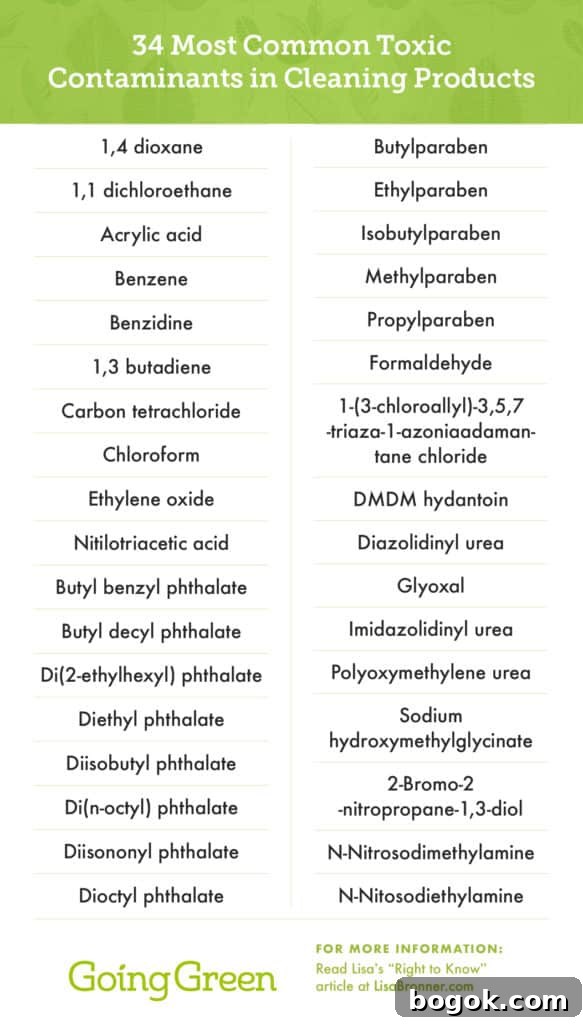
Although on-package labeling began to be required in 2021, retailers are allowed to sell through existing stock, so you may not see updated labels on store shelves immediately. Any product manufactured after the compliance date must meet the new on-package disclosure rules.
The law also requires manufacturers to keep disclosures current with updates to authoritative lists of chemicals of concern. When a chemical is added to those lists because of new research or recognition of harm, manufacturers must disclose it accordingly.
There are a few limited exceptions and specific conditions:
- Disinfectants: Because these products are regulated as pesticides at the federal level, ingredient disclosure for disinfectants is required online only.
- Trade secret protection: Manufacturers may claim confidential business information (CBI) status for non-hazardous ingredients under a defined state process. Such claims require documentation and can be audited.
- Prop 65-listed ingredients: Disclosure for ingredients listed under California’s Proposition 65 had a later compliance date to allow manufacturers time to reformulate products away from listed chemicals.
- Trial sizes: Small sample or trial-size products may provide direction on the package to view full ingredient information on the manufacturer’s website rather than listing every ingredient on the small package.
The law’s transparency requirements for fragrances and contaminants are especially important. Fragrance ingredients have been linked in studies to hormone disruption, respiratory issues, allergies, and reproductive harm. Contaminants can appear unintentionally through manufacturing processes and can include harmful byproducts. Under the new rules, hazardous fragrance components and hazardous contaminants cannot be hidden behind trade-secret claims; they must be disclosed.
Importantly, the law does not force manufacturers to reformulate products. Instead, it requires them to disclose what is already in their products. That transparency equips consumers with the information needed to pressure companies to change formulations if they choose to avoid certain ingredients.
For the time being, consumers must do some homework. From 2020 onward, ingredient lists are available online, and shoppers who want to evaluate safety will need to consult reputable resources to understand ingredient risks. Advocacy groups and independent databases can help decode ingredient functions and hazards.
While this regulation currently applies to one state, it represents a major step forward for public awareness and may influence broader national practices. Increased transparency gives consumers the data they need to make choices aligned with their health priorities and to advocate for safer products.
Companies that already list full ingredients on their labels demonstrate the standard this law promotes: clear, honest disclosure so shoppers can make informed decisions. Greater transparency benefits everyone by creating a marketplace where safety and clarity matter.
Further reading
- 13 Essential Green Cleaning Ingredients
- All-Purpose Cleaning Spray: How to Choose and Use
- 12 Personal Care Ingredients to Know and Avoid