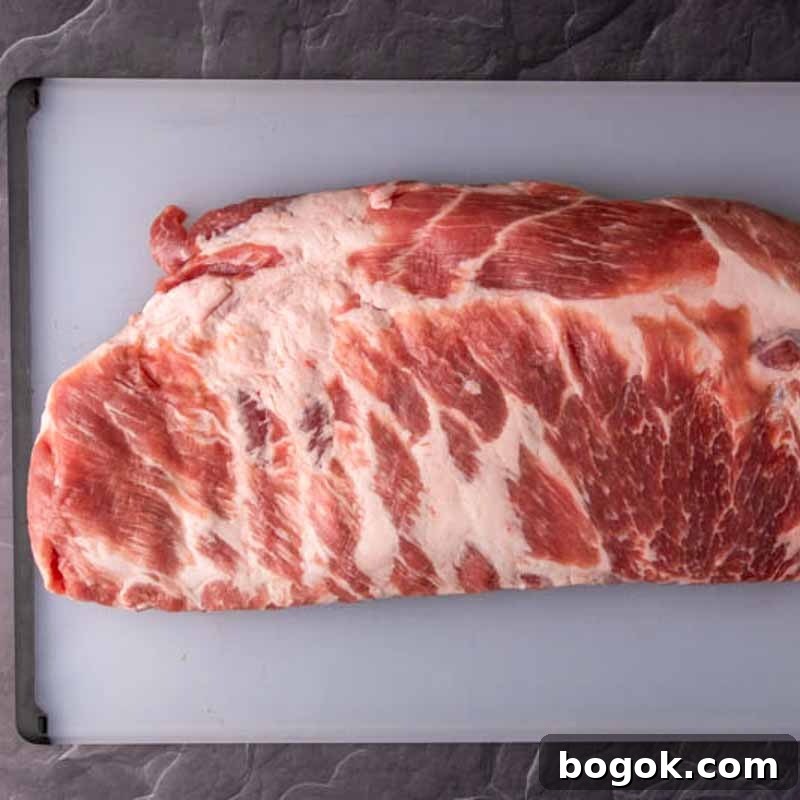
Trimming a full, “prehistoric” rack of spare ribs into a neat St. Louis cut is one of the first professional skills every pitmaster should learn. There’s a real satisfaction in turning a large, irregular slab into a clean rectangle. Beyond presentation, a squared rack cooks more evenly on your Big Green Egg, giving consistent results across every bone.
Before we grab the knife, let’s clarify what spare ribs are. Spare ribs come from the pig’s belly and are longer than baby back ribs. They share the same region as bacon, so the meat carries good marbling and flavorful fat. While the meat layer over the bones may be thinner than on baby backs, the rendered fat adds depth and richness that many barbecue purists prefer.
A St. Louis style spare rib is simply a full rack that’s been trimmed to remove the breastbone and excess cartilage, producing a uniform rectangle. That tidy shape is the standard in KCBS competition pits. Learning to find the natural break and trim confidently improves both presentation and cook consistency. So relax with a cold beverage and let’s walk through How to Trim St. Louis Style Spare Ribs.
The Anatomy of a Full Rack
A full rack straight from the butcher will look much larger and less uniform than a trimmed St. Louis rack. The breastbone and extra cartilage—often called the brisket bone—remain attached, making the slab bulky and uneven.
That extra cartilage and connective tissue renders much more slowly than the ribs themselves. If you leave it on, thin ends can overcook before the thick breastbone section becomes tender. To achieve an even cook and a polished look on the Big Green Egg, you need to find the natural break and square the rack.
Step 1: The Skirt and the Flap
Start by cleaning up the underside of the rack.
The Trim: Use a sharp, flexible boning knife to remove the flap flush with the rack. Don’t discard this scrap—grill it as a snack or save it for stock.
The Skirt Meat: Flip the rack bone-side up. You’ll see a thin strip of meat running along the center of the rack—this is the skirt. It overlays the membrane and will char if left attached.
Step 2: Removing the Membrane
Next is a professional move: remove the membrane, or silverskin. With the bone side facing up, locate the thin, white translucent film covering the bones. This membrane acts like a barrier—if left on, it prevents rub and smoke from penetrating the meat and becomes tough after cooking.
The Pull: Grip a flap of the membrane and pull straight up and away. Ideally it will peel off in one piece; if it tears, keep working until the bones are exposed.
The Butter Knife Trick: Instead of using a sharp knife, slide a blunt butter knife under the membrane at about the third bone to loosen it. Then use a paper towel to get a secure grip and pull it free.
Step 3: Removing the Rib Tips
The last major trim is removing the rib tips—the thicker meat and cartilage section above the ribs. These tips cook at a different rate than the rib bones and should be separated for consistency.
- Finding the “Hinge”: Fold the rack lengthwise as if closing a book. The solid rib bones won’t bend, but the rib tip area will. That bend marks the separation.
- The Cut: Follow that hinge with your knife. The line isn’t always perfectly straight—if the section bends, it’s coming off. Trim until you have a clean, rectangular rack.
Pro Tip: Keep the trimmings. Rib tips make excellent snacks while the main rack smokes, or chop them up as an appetizer for guests.
The Finish Line
Once the skirt is removed, the rack squared, the membrane pulled, and the tips separated, your ribs are ready for smoke. You’ve converted a bulky slab into a competition-ready, evenly cooking rack.
The Next Step: Put Your Skills to the Test
With a properly trimmed St. Louis rack you’ve created a perfect canvas for flavor. A uniform rack reduces the risk of burnt ends and lets you focus on seasoning and smoke. Whether you go classic or experiment with bold profiles, a well-trimmed rack makes all the difference on the Big Green Egg.
Top Ways to Cook a Trimmed Rack
- Hot and fast: A quicker competition-style cook for tender, saucy ribs without a full-day smoke.
- Korean-inspired: Sweet, spicy, and savory flavors that highlight the rib’s fat and texture.
- Classic smoked: A traditional approach focused on a great rub and clean smoke ring.
- Two-protein cook: Maximize your Egg by cooking ribs alongside chicken for a full spread.
Why the Trim Matters
Barbecue is about control. Spending ten minutes on a proper St. Louis trim gives you more control over heat, airflow, and presentation. It elevates your approach from “throwing meat on the grill” to deliberate pitmastery. Guests will notice the difference in both appearance and the first flavorful bite.
How to Trim St. Louis Style Spare Ribs
Ingredients
-
1 full rack of spare ribs
Instructions
-
Remove the skirt: Flip the ribs so the bone side faces up. The skirt is the strip of meat that runs along the membrane. If left on, that end will take longer to cook because it’s thicker. Slide a knife under the skirt and remove it. Save it for stock or as a snack. Trim more as needed to ensure an even rack.
-
Remove the membrane: With the bone side up, find the white film covering the bones. Use a butter knife to lift the membrane around the third bone, then grab the lifted flap with a paper towel and pull straight up and away until the membrane comes off.
-
Remove the rib tips: Fold the rack lengthwise; the ribs won’t bend but the rib tip section will. Cut along that hinge where the rack bends to separate the rib tips from the bones. Trim until only the clean, rectangular rack remains. Your ribs are now ready to smoke.
Nutrition information is automatically calculated and should be used only as an approximation.
Additional Info